At the invitation of Chinese President Xi Jinping, President of Myanmar Min Aung Hlaing will pay a state visit to China from June 15 to 19, a Chinese foreign ministry spokesperson announced on Friday.
During the visit, President Xi will hold talks with President Min Aung Hlaing. Premier Li Qiang and Zhao Leji, chairman of the Standing Committee of the National People's Congress, will meet with him respectively, Chinese foreign ministry spokesperson Lin Jian told a daily press briefing.
Noting that China and Myanmar are traditional friendly neighbors and a community with a shared future, Lin said over the 76 years since the establishment of diplomatic ties, guided by the spirit of the Five Principles of Peaceful Coexistence jointly advocated by the two sides, China and Myanmar have stood together through thick and thin, looked out for each other and forged solidarity and cooperation, promoting China-Myanmar relations to achieve considerable progress.
Lin said through President Min Aung Hlaing's visit, China looks forward to working with Myanmar to carry forward the "pauk-phaw" (fraternal) friendship, deepen the comprehensive strategic cooperative partnership, secure more tangible results in building the China-Myanmar community with a shared future, and deliver further benefits to the two peoples.
Wang Yi, Chinese foreign minister and member of the Political Bureau of the Communist Party of China Central Committee, held talks with his Myanmar counterpart Tin Maung Swe in Beijing on Friday.
China stands ready to work with Myanmar's new government to strengthen high-level exchanges, enhance political mutual trust, and deepen strategic cooperation, in order to deliver more practical outcomes in building a China-Myanmar community with a shared future and to help Myanmar accelerate development, he said.
The Chinese Embassy in Romania on Saturday expressed serious concern and firm opposition to a recent visit to Taiwan region by Romanian lawmaker Alexandru Muraru and his subsequent erroneous remarks concerning Taiwan region, saying his actions violated Romania's official policy and advocated for the DPP authorities' "Taiwan independence" separatist agenda.
According to the statement published on the embassy's official WeChat account, a spokesperson for the embassy said Taiwan is part of China, and both the mainland and Taiwan belong to one China. This is a historical and legal fact, the true status quo across the Taiwan Straits, and an important component of the post-World War II international order.
The spokesperson said that recognizing the government of the People's Republic of China as the sole legal government representing the whole of China and adhering to the one-China principle are widely accepted by the international community and constitute a basic norm governing international relations.
Romania established diplomatic relations with the People's Republic of China in 1949, the spokesperson noted, adding that the one-China principle has served as the political foundation of bilateral relations and ensured the steady development of China-Romania ties despite changes in the international landscape.
The statement noted that the Taiwan question is China's internal affair and lies at the core of China's core interests. "Just as a province or region of Romania cannot separate from the country for any reason, Taiwan cannot separate from China for any reason," the spokesperson said.
Quoting the Chinese saying, "Do not impose on others what you yourself do not desire," the spokesperson said Muraru's actions constituted blatant interference in China's internal affairs and support for "Taiwan independence," adding that such behavior not only runs counter to basic diplomatic norms but also raises questions about whether he is genuinely acting in Romania's interests.
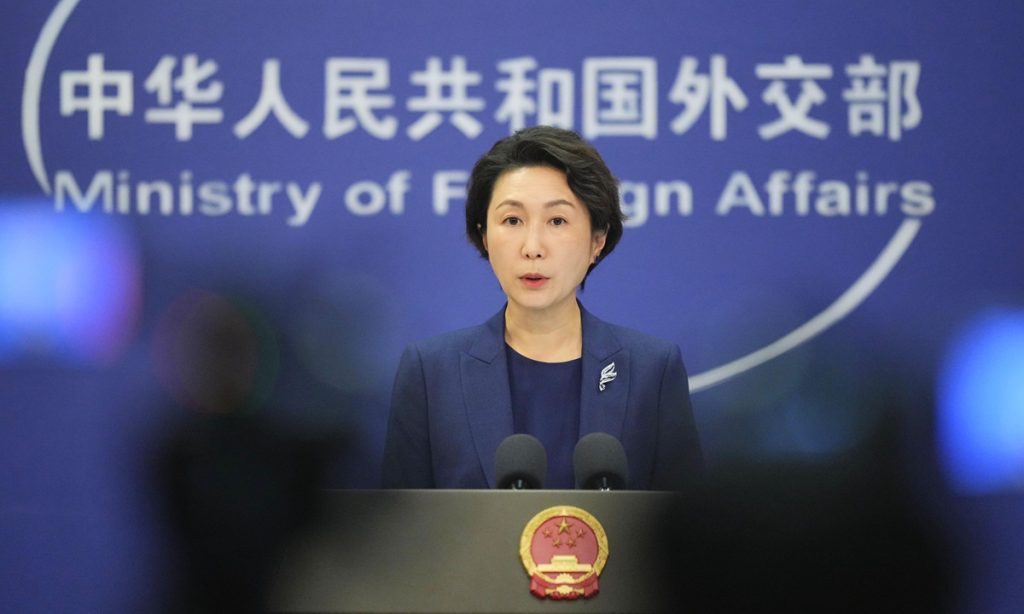
China Foreign Ministry spokesperson Mao Ning said Philippine Defense Secretary Gilberto Teodoro has repeatedly made fallacious remarks about China and his latest statements once again prove his having no gratitude for key Chinese commodities and exploiting issues of people's livelihoods to make political stunt.
Mao made the remarks on Tuesday, commenting on media reports that Teodoro alleged at the Shangri-La Dialogue that China had provided fertilizer and fuel to the Philippines but did not show good faith on a long-term basis, and "no matter how they sugarcoat their assistance to us, it doesn't cut the mustard." He also claimed the Philippines were under severe threat territory-wise and politically by China.
Mao stated that Teodoro's latest words shows that he completely disregards the welfare of the Philippine people, lacks any sense of gratitude, only cares about his personal interests, and is even exploiting livelihood issues for political stunt, which damages China-Philippines relations and mutual trust, and is completely contrary to the interests of the Philippine nation and its people.
Mao further asked: The Philippine side should seriously reflect on this. If it allows such a person to do whatever he wants, how can China continue to provide material assistance to the Philippines? Who will ultimately foot the bill? Whose interests will be harmed?
Mao noted that Philippine leaders have repeatedly expressed their willingness to properly resolve differences with China and promote the easing of bilateral relations. It is hoped that the Philippines will match its words with deeds, strictly discipline its officials, and not allow a few clowns to repeatedly undermine bilateral efforts to stabilize the relationship, Mao added.
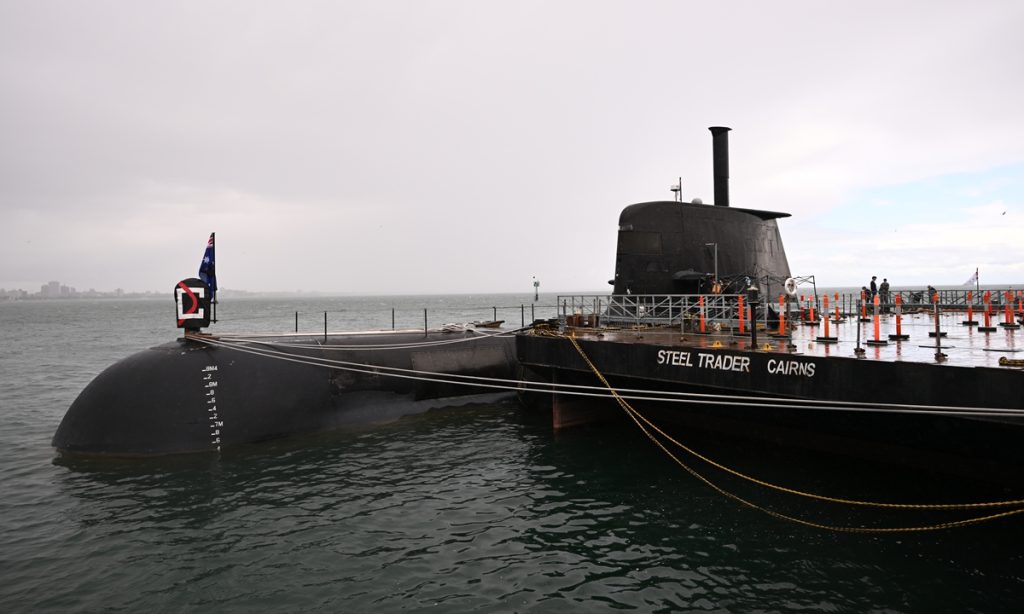
Former Australian environment minister Peter Garrett will head up a crowd-funded review of the multi-billion-dollar AUKUS submarine deal, Australia's biggest ever defense project, with one of its questions including an examination of how the deal affects Australia's relations with China, BBC News reported. A Chinese expert said this reflects a growing number of voices within Australia questioning whether it is worthwhile to sacrifice relations with China in order to accommodate US interests.
Launched by a group of Labor veterans and public figures concerned that proper scrutiny was not applied to the deal, the inquiry will hold public hearings and take written submissions before delivering a final report by October 30, the Guardian reported.
Garrett, who served as environment minister between 2007 and 2010, said the independent inquiry into the A$368 billion ($239 billion) deal - where Australia will buy second-hand US submarines to replace its ageing fleet - was "long overdue," the BBC reported.
He also said the inquiry would consider if the submarines can be delivered on time and on budget, how nuclear waste will be managed and if Australia's defense and strategic interests are well served by the deal, the Guardian reported.
This inquiry has dealt a blow to the AUKUS pact, while also reflecting concerns among some Australian Labor Party figures over the prospects of the AUKUS nuclear submarine program, its staggering costs, distrust of the US government, and the program's implications for Australia's sovereignty, Ning Tuanhui, an associate research fellow at the China Institute of International Studies, told the Global Times on Wednesday.
After Garrett's inquiry, Labor backbencher Ed Husic urged a new vote on the future of the AUKUS submarine pact, warning the deal as it stood could impact sovereignty, news outlet The Australian reported.
Ning said these developments have left the Anthony Albanese administration caught between internal rifts within its own party and relentless opposition censure, placing the government under mounting pressure from two flanks.
"This will likewise cast tangible headwinds over the administration's future efforts to advance the pact," he added.
The BBC reported that the inquiry will ask how the deal will affect Australia's relationship with China, its largest trading partner.
The inquiry specifically calls for an assessment of AUKUS's impact on China-Australia relations, indicating that some figures within Australia are rethinking whether sacrificing ties with China to align with US geopolitical objectives truly serves Australia's national interests, Chen Hong, director of the Asia-Pacific Studies Center at East China Normal University, told the Global Times.
The AUKUS deal was announced in September 2021, and while it is not explicitly stated, it is believed to be about countering China's growing presence in the so-called Indo-Pacific region, and about the South China Sea issue, according to a BBC report.
A growing number of Australians clearly see that the US prioritizes its own interests, not those of its allies, and the consensus is also deepening that relying on the Chinese market while proactively defining China as a potential adversary is a strategic contradiction, Chen added.
Concerns are growing within Australia over the US role in and commitment to the AUKUS pact. Husic warned that Australia needs a backup plan for the AUKUS submarine agreement, arguing that sluggish US production and the "transactional nature" of the current US administration have put the multibillion-dollar defense deal at risk, per BBC News.
Arthur Rorris, the secretary of the South Coast Labour Council, which opposes the establishment of a nuclear submarine base at Port Kembla, said the proposed base was never intended for Australian submarines but "would be ceded to the US navy as a staging post for their 7th fleet," the Guardian reported.
Australia's case underscores that tying one's strategic and economic fortunes to the US at steep costs may yield heightened troubles and lingering uncertainties, serving as a sobering wake-up call for Washington's other allies, Ning said.
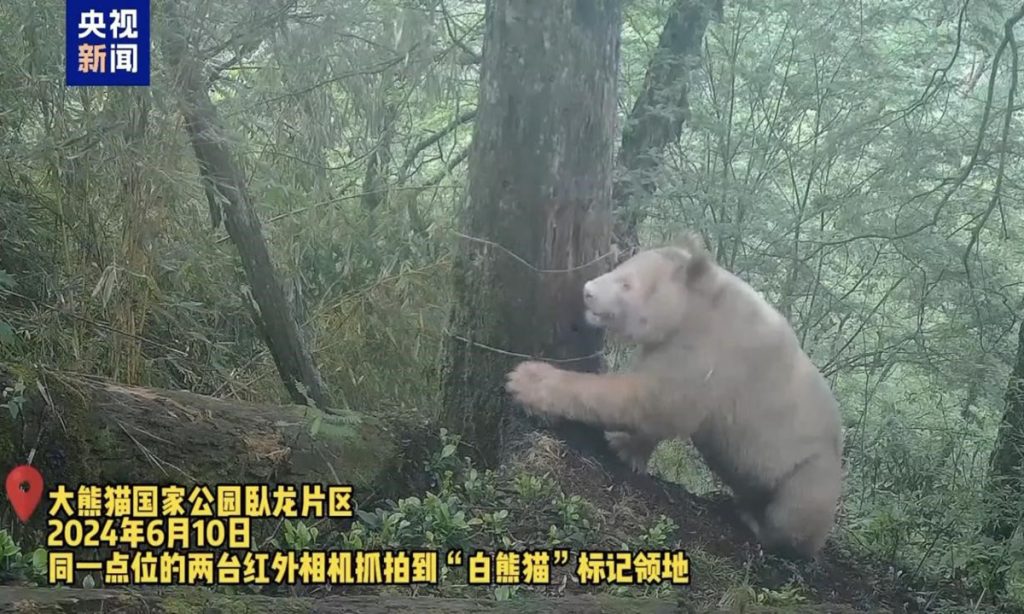
Newly released footage from the Wolong area of Giant Panda National Park in Southwest China's Sichuan Province shows the world's only known wild white panda wandering across snow-blanketed forests and bamboo groves, chinanews.com reported.
This was the first time in several years that the rare albino giant panda has been fully captured by an infrared-triggered camera equipped with real-time transmission capabilities, the report said.
The footage shows the all-white giant panda calmly roaming through dense forests and bamboo groves, pausing at times to forage for food and patrol its habitat.
Compared with its appearance as a cub when first discovered in 2019, the white giant panda has now reached adulthood, and appears healthy and agile. It appears to have adapted exceptionally well to the wild, and its natural habitat independently, according to chinanews.com.
According to Tan Yingchun, project lead of the conservation and research program for white giant pandas at the Wolong National Nature Reserve, judging by footage captured by infrared cameras, this white giant panda boasts a robust physique, and the fur of its limbs tint faint golden-brown in adulthood.
The panda is seen moving solo in every recorded clip, leading researchers to estimate its age at around 9 and conclude that it has long been fully independent.