Two more teeny moons might be lurking around Uranus. That’s in addition to the 27 we already know about. Fluctuations in the density of two of the planet’s dark rings, seen in radio data from the 1986 flyby of the Voyager 2 spacecraft, could be caused by unseen moonlets, Robert Chancia and Matthew Hedman, astronomers at the University of Idaho in Moscow, report online October 9 at arXiv.org.
At probably just 4 to 14 kilometers wide, both moons would be very difficult to detect in Voyager 2 images, the researchers report. New observations with ground-based telescopes might have better luck.
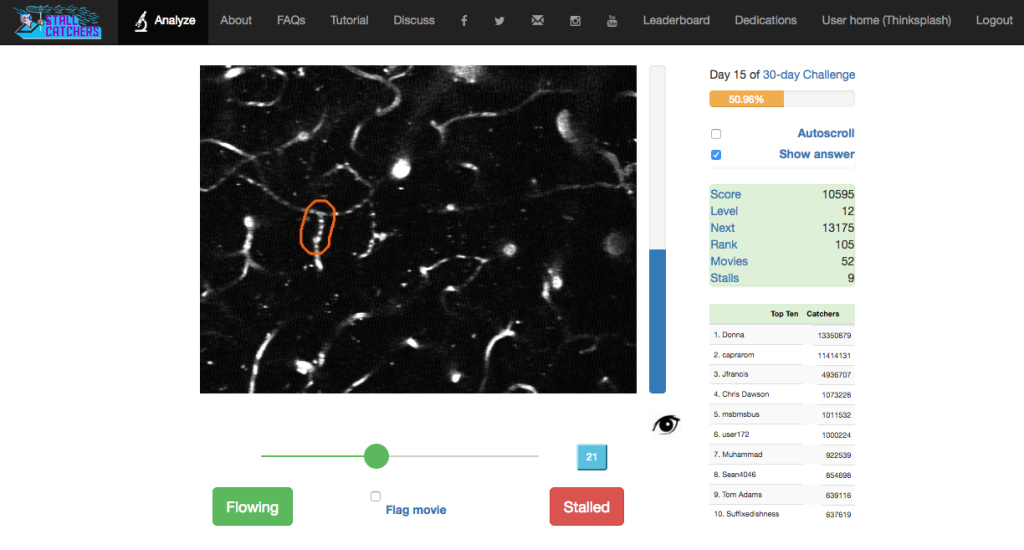
Traffic jams in the brain’s blood supply may play a role in Alzheimer’s disease. A new online game turns people at home into amateur traffic cops. This policing, which involves spotting hard-to-see sluggishness in tiny capillaries in mice, may ultimately help scientists better understand, and perhaps even treat, Alzheimer’s, a devastating disorder that affects over 5 million Americans.
The science behind the game, called Stall Catchers, comes from Cornell University. Chris Schaffer, Nozomi Nishimura and colleagues found that mice designed to exhibit symptoms similar to Alzheimer’s have more blocked blood vessels in their brains than regular mice. That difference can deprive the brain of sustenance and may be a key to understanding how Alzheimer’s damages the brain, the researchers suspect. But finding congested capillaries is a slog. Computers haven’t been up to snuff, and experts could spend an entire year analyzing the thousands of microscope images needed to amass enough data to explore links between Alzheimer’s and blocked vessels. “I thought, if we could change that, it would be tremendous,” says Pietro Michelucci, director of the Human Computation Institute in Fairfax, Va. The institute is a nonprofit organization that runs the EyesOnALZ program, which aims to crowdsource Alzheimer’s research.
That’s where StallCatchers.com comes in. The website asks players to sift through short black-and-white videos of real mouse brains, on the prowl for blocked blood vessels. In the videos, moving blood appears white. But stationary black segments that appear between two white segments signal trouble — a stall. Players rack up points and ascend levels as they classify vessels. With practice, the task gets easier. And people who suffer from performance anxiety shouldn’t fret; each video will be scrutinized by multiple users to get the final verdict. With a little help from the crowd, “not only do [researchers] get answers faster, but they can ask more questions,” Michelucci says.
So far, nearly 1,000 users have played Stall Catchers, Michelucci says. Those players are beginning to generate data that will let researchers see how good these amateur traffic cops are. With luck, their eyes will help unstall the fight against Alzheimer’s.
A “three-parent baby” was born in April, the world’s first reported birth from a controversial technique designed to prevent mitochondrial diseases from passing from mother to child.
“As far as we can tell, the baby is normal and free of disease,” says Andrew R. La Barbera, chief scientific officer of the American Society for Reproductive Medicine. “This demonstrates that, in point of fact, the procedure works.”
The baby boy carries DNA not only from his mother and father but also from an egg donor, raising both safety and ethical concerns. In particular, people worry that alterations of the genetic makeup of future generations won’t stop with preventing diseases but could lead to genetically enhanced “designer babies.” Opponents, such as Marcy Darnovsky, executive director of the Center for Genetics and Society in Berkeley, Calif., are also worried that the technique hasn’t been fully tested. “We wish the baby and family well, and hope the baby stays healthy,” Darnovsky says. “But I have a lot of concerns about this child and about future efforts to use these techniques before they’ve been shown to be safe.”
About one in 4,000 children are born with dysfunctional mitochondria. These energy-generating organelles are inherited from the mother and have their own DNA. Mutations in some of the 37 mitochondrial genes can lead to fatal diseases, often affecting energy-hungry organs such as the brain and muscles. Because there is no cure or effective treatment for many mitochondrial diseases, the recent birth has been heralded as a sign of new hope for affected families.
Even if women don’t have mitochondrial diseases themselves, they can pass the diseases to their children if their egg cells contain large numbers of defective mitochondria. The mother of the recent three-parent baby had previously had two children who died of Leigh syndrome, a mitochondrial disease that affects the nervous system and eventually prevents a person from breathing.
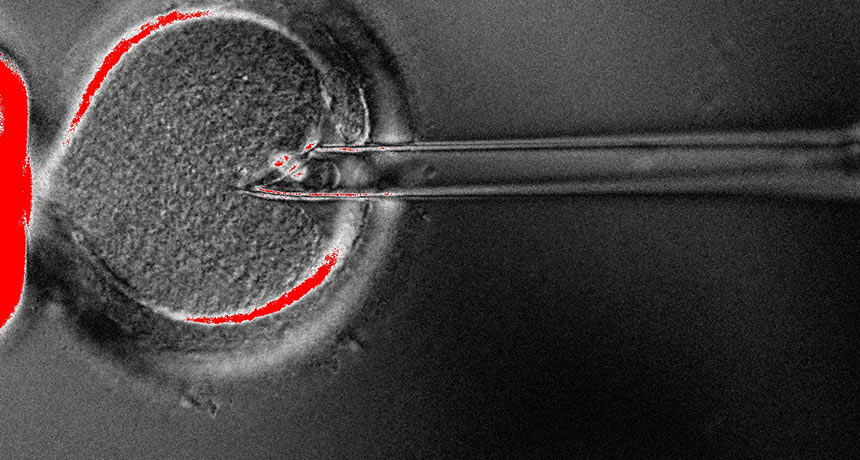
Fertility doctor John Zhang of the New Hope Fertility Center in New York City and colleagues performed what’s called a spindle transfer to put all the chromosomes from the mother’s egg into a donor egg that contained healthy mitochondria but had been emptied of its chromosomes (SN Online: 10/18/16). The egg was then fertilized with sperm and implanted in the mother.
Cell swap A baby boy born in April has DNA from three people. To produce the embryo, researchers transferred the chromosomes from the mother’s egg into a donor egg with healthy mitochondria. The technique is called “spindle transfer” for the cellular structure that segregates the chromosomes.
“It’s very important that they follow up,” to monitor the child’s long-term health, says Shoukhrat Mitalipov, a mitochondrial biologist at Oregon Health & Science University in Portland. Mitalipov pioneered the spindle transfer technique in monkeys (SN: 9/26/09, p. 8). Even a small number of defective mitochondria carried over from the mother’s egg may replicate and cause problems later on, he and other scientists have found (SN: 6/25/16, p. 8; SN Online: 11/30/16).
Zhang reported that just 1.6 percent of the baby boy’s mitochondrial DNA came from his mother (SN Online: 10/19/16). Mitalipov notes, however, that doctors can’t know from sampling a few types of tissue whether other tissues have different levels of mitochondrial carryover. What’s more, levels of mutant mitochondria may change as the child grows.
Mitalipov supports research on the technique but says it should be done in carefully controlled clinical trials. Results of a mouse study published in July suggest that mismatches between the parents’ nuclear DNA and the donor mitochondrial DNA could affect metabolism and aging (SN: 8/6/16, p. 8). Those effects could show up years or decades after birth.
The baby boy born in April is technically not the first three-parent baby. At least two children born in the late 1990s carry mitochondrial DNA from a donor. Those two and 15 other children were born to mothers who had a small amount of cytoplasm — the gelatinous fluid that fills cells and holds mitochondria — from a donor egg injected into their own eggs in an effort to improve results of in vitro fertilization. No major health problems have been reported, but the studies were abandoned because of ethical concerns, lack of funding and the difficulties in obtaining newly required permits.
La Barbera disputes the term “three-parent baby” entirely. “A person’s essence as a human being comes from their nuclear genetic material, not their mitochondrial genetic material,” La Barbera says. Children who are born after mitochondrial transfer procedures have only two parents, he contends.
Zhang drew fire for going to Mexico to perform the procedure. Congress currently bars the U.S. Food and Drug Administration from reviewing applications to make heritable changes in human embryos, which includes the spindle transfer technique. A panel of experts said in February that it is ethical to make three-parent baby boys (SN Online: 2/3/16), a provision that would prevent future generations from inheriting the donor mitochondria. Because mothers pass mitochondria on to their babies but fathers usually do not, technically baby boys born through this technique don’t carry an inheritable modification in their DNA.
Clinics in the United Kingdom can legally perform the procedures, but none have been reported yet. A panel of experts there recommended November 30 that clinical studies could move ahead, so more babies may be born in 2017.
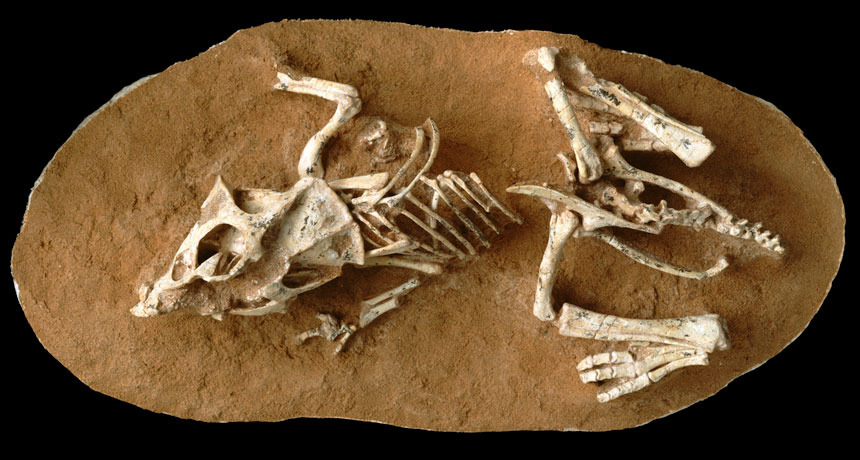
Dinosaurs might live on today as birds, but they hatched like reptiles. Developing dinos stayed in their eggs three to six months before emerging, far longer than previously suspected, researchers report online January 3 in the Proceedings of the National Academy of Sciences.
With few clues to dinosaurs’ embryonic lives, scientists assumed that young dinosaurs shared modern birds’ swift incubation period, which ranges from 45 to 80 days for eggs in the size range of dino eggs. A reptile egg generally takes about twice as long to hatch as a bird egg of similar size, says lead author Gregory Erickson, a paleobiologist at Florida State University in Tallahassee. But counts of growth lines on the teeth of rare fossilized dinosaur embryos from two species, Protoceratops andrewsi and Hypacrosaurus stebingeri, suggest a longer trajectory like that of reptiles, say Erickson and colleagues at the University of Calgary in Canada and the American Museum of Natural History in New York City. These lines, laid down daily on teeth, can be used like tree rings.
The longer incubation time might have worked against dinosaurs, Erickson says. Guarding a brood of eggs for many months could put parents at risk of attack. And a species hit by environmental catastrophe would have a harder time bouncing back.
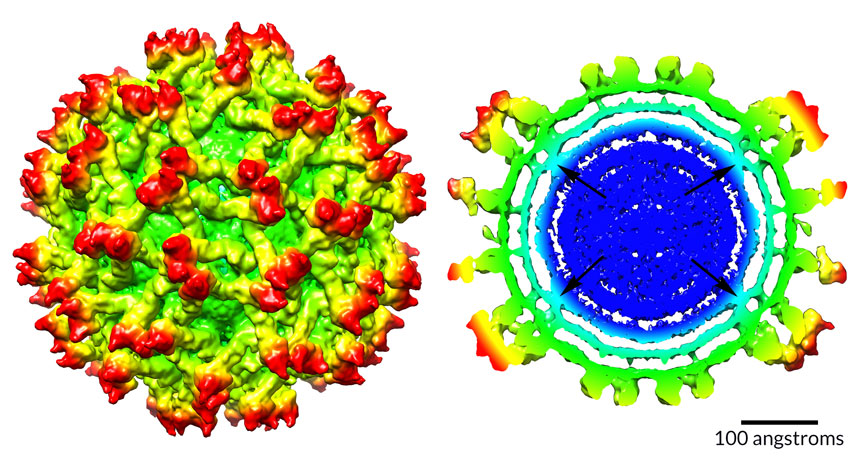
Before an immature Zika virus becomes infectious, it does some major remodeling.
In a fledgling virus particle, the inner protein and RNA core (shown in dark blue above, right) forms bridges to the membrane layer that surrounds it. As the virus matures, the core shuffles around and the bridges melt away (below, right).
It’s the first time scientists have seen such rearrangement in the core of a flavivirus, the group that also includes the viruses that cause dengue, West Nile and yellow fever, says virologist Richard Kuhn of Purdue University in West Lafayette, Ind. Scientists don’t know why the immature Zika virus reshuffles its insides, Kuhn says — perhaps it helps the maturing virus become infectious. But that’s the next big question to answer, he says.
If blocking the reorganization somehow made mature viruses harmless, scientists would have a new clue about preventing Zika infection. Kuhn and colleagues’ map of the immature virus’s structure, published online January 9 in Nature Structural & Molecular Biology, could offer other hints for thwarting Zika.
With a technique called cryo-electron microscopy, the team could see three-headed protein spikes (shown in red) studding the surface like some kind of medieval weapon, and could even distinguish the separate layers of the membrane (aqua) that encloses the core. (The maps are radially colored; colors change as distance from the core increases.) Outside the membrane lie surface proteins called envelope, or E, proteins (green and yellow) that help the virus sneak into cells.
Last year, Kuhn’s team reported the structure of the mature Zika virus (SN: 4/30/16, p. 10). The new work offers another illuminating peek at Zika — a baby picture, of sorts.
Any exercise — even the weekend warrior approach, cramming it all into Saturday and Sunday — is better than none. Compared with inactive adults, those who got the recommended amount of weekly exercise, or even substantially less, had about a one-third lower risk of death during the study period, researchers report online January 9 in JAMA Internal Medicine.
Gary O’Donovan at the University of Leicester in England and colleagues analyzed data from 63,591 people ages 40 and older, surveyed between 1994 and 2012 as part of the Health Survey for England and the Scottish Health Survey. Adults should be getting 150 minutes of moderate activity (such as walking) or 75 minutes of vigorous activity (such as jogging) spread out across the week, according to the U.S. Centers for Disease Control and Prevention and the World Health Organization. Measured against people who did absolutely nothing, active people who worked up a sweat three or more times per week, weekend warriors and even those who moved less (60 minutes per week on average) all reduced their risk of dying early. The observational study can’t say that exercise caused the reduced risk, just that there’s an association.
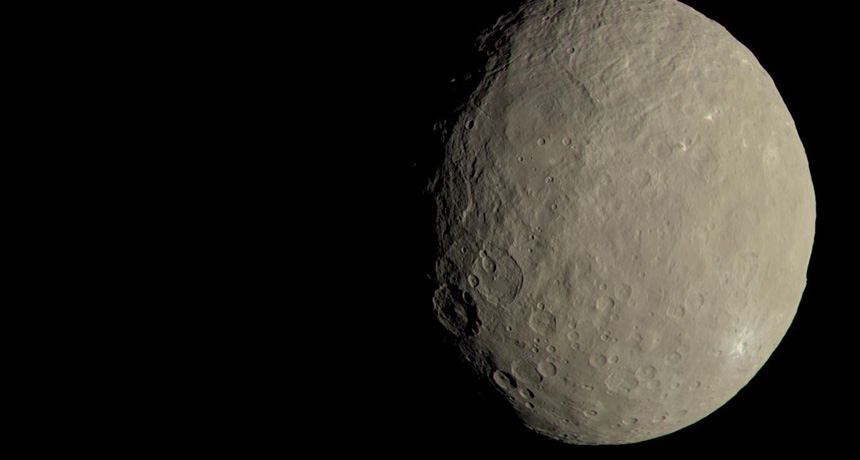
NASA’s Dawn spacecraft has detected organic compounds on Ceres — the first concrete proof of organics on an object in the asteroid belt between Mars and Jupiter.
This material probably originated on the dwarf planet itself, the researchers report in the Feb. 17 Science. The discovery of organic compounds adds to the growing body of evidence that Ceres may have once had a habitable environment.
“We’ve come to recognize that Ceres has a lot of characteristics that are intriguing for those looking at how life starts,” says Andy Rivkin, a planetary astronomer at the Johns Hopkins University Applied Physics Laboratory in Laurel, Md., who was not involved in the study. The Dawn probe has previously detected salts, ammonia-rich clays and water ice on Ceres, which together indicate hydrothermal activity, says study coauthor Carol Raymond, a planetary scientist at NASA’s Jet Propulsion Laboratory in Pasadena, Calif.
For life to begin, you need elements like carbon, hydrogen, nitrogen and oxygen, as well as a source of energy. Both the hydrothermal activity and the presence of organics point toward Ceres having once had a habitable environment, Raymond says.
“If you have an abundance of those elements and you have an energy source,” she says, “then you’ve created sort of the soup from which life could have formed.” But study coauthor Lucy McFadden, a planetary scientist at NASA’s Goddard Space Flight Center in Greenbelt, Md., stresses that the team has not actually found any signs of life on Ceres.
Evidence of Ceres’ organic material comes from areas near Ernutet crater. Dawn picked up signs of a “fingerprint,” or spectra, consistent with organics. The pattern of wavelengths of light absorbed and reflected from these areas is similar to the pattern seen in hydrocarbons on Earth such as kerite and asphaltite. But without a sample from the surface, the team can’t say definitively what organic material is present or how it formed, says study coauthor Harry McSween, a geologist at the University of Tennessee. The team suspects that the organics formed within Ceres’ interior and were brought to the surface by hydrothermal activity. An alternative idea — that a space rock that crashed into Ceres brought the material — is unlikely, the researchers say, because the concentration of organics is so high. An impact would have mixed organic compounds across the surface, diluting the concentration.
Detecting organics on Ceres also has implications for how life arose on Earth, McSween says. Some researchers think that life was jump-started by asteroids and other space rocks that delivered organic compounds to the planet. Finding such organic matter on Ceres “adds some credence to that idea,” he says.
Big data is everywhere these days and police departments are no exception. As law enforcement agencies are tasked with doing more with less, many are using predictive policing tools. These tools feed various data into algorithms to flag people likely to be involved with future crimes or to predict where crimes will occur.
In the years since Time magazine named predictive policing as one of 2011’s best 50 inventions of the year, its popularity has grown. Twenty U.S. cities, including Chicago, Atlanta, Los Angeles and Seattle are using a predictive policing system, and several more are considering it. But with the uptick in use has come a growing chorus of caution. Community activists, civil rights groups and even some skeptical police chiefs have raised concerns that predictive data approaches may unfairly target some groups of people more than others.
New research by statistician Kristian Lum provides a telling case study. Lum, who leads the policing project at the San Francisco-based Human Rights Data Analysis Group, looked at how the crime-mapping program PredPol would perform if put to use in Oakland, Calif. PredPol, which purports to “eliminate profiling concerns,” takes data on crime type, location and time and feeds it into a machine-learning algorithm. The algorithm, originally based on predicting seismic activity after an earthquake, trains itself with the police crime data and then predicts where future crimes will occur.
Lum was interested in bias in the crime data — not political or racial bias, just the ordinary statistical kind. While this bias knows no color or socioeconomic class, Lum and her HRDAG colleague William Isaac demonstrate that it can lead to policing that unfairly targets minorities and those living in poorer neighborhoods.
By applying the algorithm to 2010 data on drug crime reports for Oakland, the researchers generated a predicted rate of drug crime on a map of the city for every day of 2011. The researchers then compared the data used by the algorithm — drug use documented by the police — with a record of overall drug use, whether recorded or not. This ground-truthing came from taking public health data from the 2011 National Survey on Drug Use and Health and demographic data from the city of Oakland to derive an estimate of drug use for all city residents. In this public health-based map, drug use is widely distributed across the city. In the predicted drug crime map, it is not. Instead, drug use deemed worthy of police attention is concentrated in neighborhoods in West Oakland and along International Boulevard, two predominately low-income and nonwhite areas. Predictive policing approaches are often touted as eliminating concerns about police profiling. But rather than correcting bias, the predictive model exacerbated it, Lum said during a panel on data and crime at the American Association for the Advancement of Science annual meeting in Boston in February. While estimates of drug use are pretty even across race, the algorithm would direct Oakland police to locations that would target black people at roughly twice the rate of whites. A similar disparity emerges when analyzing by income group: Poorer neighborhoods get targeted. And a troubling feedback loop emerges when police are sent to targeted locations. If police find slightly more crime in an area because that’s where they’re concentrating patrols, these crimes become part of the dataset that directs where further patrolling should occur. Bias becomes amplified, hot spots hotter.
There’s nothing wrong with PredPol’s algorithm, Lum notes. Machine learning algorithms learn patterns and structure in data. “The algorithm did exactly what we asked; it learned patterns in the data,” she says. The danger is in thinking that predictive policing will tell you about patterns in the occurrence of crime. It’s really telling you about patterns in police records.
Police aren’t tasked with collecting random samples, nor should they be, says Lum. And that’s all the more reason why departments should be transparent and vigilant about how they use their data. In some ways, PredPol-guided policing isn’t so different from old-fashioned pins on a map.
For her part, Lum would prefer that police stick to these timeworn approaches. With pins on a map, the what, why and where of the data are very clear. The black box of an algorithm, on the other hand, lends undue legitimacy to the police targeting certain locations while simultaneously removing accountability. “There’s a move toward thinking machine learning is our savior,” says Lum. “You hear people say, “A computer can’t be racist.’”
The use of predictive policing may be costly, both literally and figuratively. The software programs can run from $20,000 to up to $100,000 per year for larger cities. It’s harder to put numbers on the human cost of over-policing, but the toll is real. Increased police scrutiny can lead to poor mental health outcomes for residents and undermine relationships between police and the communities they serve. Big data doesn’t help when it’s bad data.
I’ve been to the playground enough times to know a juicy parenting controversy when I see (or overhear) one. Bed-sharing, breastfeeding and screen time are always hot-button issues. But I’m not talking about any of those. No, I’m talking about actual juice.
Some parents see juice as a delicious way to get vitamins into little kids. Others see juice as a gateway drug to a sugar-crusted, sedentary lifestyle, wrapped up in a kid-friendly box. No matter where you fall on the juice spectrum, you can be sure there are parents to either side of you. (Disclosure: My kids don’t drink much juice, simply because the people who buy their groceries aren’t all that into it. And juice is heavy.)
Scientific studies on the effects of juice have been somewhat sparse, allowing deeply held juice opinions to run free. One of the chief charges against juice is that it’s packed with sugar. An 8-ounce serving of grape juice, even with no sugar added, weighs in at 36 grams. That tops Coca-Cola, which delivers 26 grams of sugar in 8 ounces. And all of those extra sweet calories can lead to extra weight.
A recent review of eight studies on juice and children’s body weight, published online March 23 in Pediatrics, takes a look at this weight concern. It attempts to clarify whether kids who drink 100 percent fruit juice every day are at greater risk of gaining weight. After sifting through the studies’ data, researchers arrived at an answer that will please pro-juicers: Not really.
“Our study did not find evidence that consuming one serving per day of 100 percent fruit juice influenced BMI to a clinically important degree,” says study coauthor Brandon Auerbach of the University of Washington in Seattle.
The analysis found that for children ages 1 to 6, one daily serving of juice (6 to 8 ounces) was associated with a sliver of an increase in body mass index, or BMI. Consider a 5-year-old girl who started out right on the 50th percentile for weight and BMI. After a year of daily juice, this girl’s BMI may have moved from the 50th to the 52nd or 54th percentile, corresponding to a weight increase of 0.18 to 0.33 pounds over the year. That amount “isn’t trivial, but it’s not enough on its own to lead to poor health,” Auerbach says.
The results, of course, aren’t the final word. The analysis was reviewing data from other studies, and those studies came with their own limitations. For one thing, the studies didn’t assign children to receive or not receive juice. Instead, researchers measured the children’s juice-drinking behavior that was already under way and tried to relate that to their weight. That approach means that it’s possible that differences other than juice consumption could influence the results. It’s important to note the distinction here between the 100 percent fruit juice in the studies and fruit cocktails, which are fruit-flavored drinks that often come with lots of added sugar. The data on those drinks is more damning in terms of weight gain and the risk of cavities, Auerbach says.
Also worth noting: The American Academy of Pediatrics recommends that kids between ages 1 and 6 get only 4 to 6 ounces of juice a day. That’s a smaller amount than many of the kids in the studies received. And the AAP recommends babies younger than 6 months get no juice at all.
In general, whole fruits, such as apples and oranges, are better than juice because they provide fiber and other nutrients absent from juice. (Bonus for toddlers: Oranges are fun to peel. Bummer for parents: Doing so makes a sticky mess.)
Still, the new analysis may ease some guilt around letting the juice flow. And it can enable parents to save their worries for more harmful things, of which there are plenty.
Like 1980s hair bands, male cockatoos woo females with flamboyant tresses and killer drum solos.
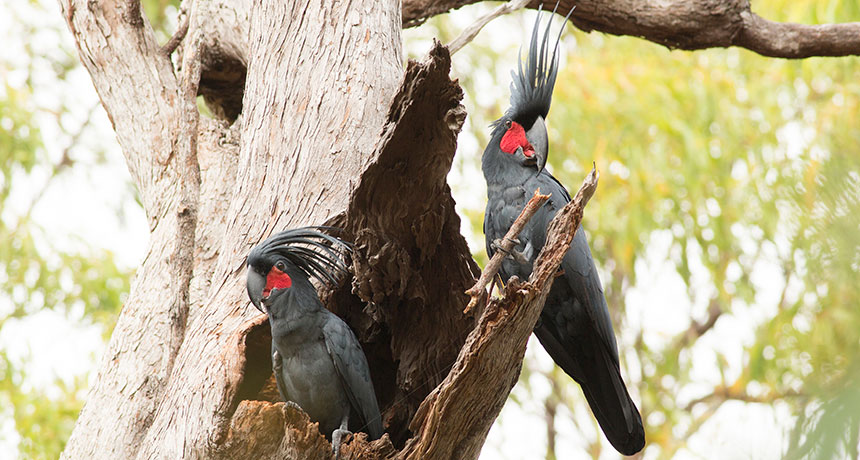
Male palm cockatoos (Probosciger aterrimus) in northern Australia refashion sticks and seedpods into tools that the animals use to bang against trees as part of an elaborate visual and auditory display designed to seduce females. These beats aren’t random, but truly rhythmic, researchers report online June 28 in Science Advances. Aside from humans, the birds are the only known animals to craft drumsticks and rock out. “Palm cockatoos seem to have their own internalized notion of a regular beat, and that has become an important part of the display from males to females,” says Robert Heinsohn, an evolutionary biologist at the Australian National University in Canberra. In addition to drumming, mating displays entail fluffed up head crests, blushing red cheek feathers and vocalizations. A female mates only every two years, so the male engages in such grand gestures to convince her to put her eggs in his hollow tree nest.
Heinsohn and colleagues recorded more than 131 tree-tapping performances from 18 male palm cockatoos in rainforests on the Cape York Peninsula in northern Australia. Each had his own drumming signature. Some tapped faster or slower and added their own flourishes. But the beats were evenly spaced — meaning they constituted a rhythm rather than random noise.
From bonobos to sea lions, other species have shown a propensity for learning and recognizing beats. And chimps drum with their hands and feet, sometimes incorporating trees and stones, but they lack a regular beat.
The closest analogs to cockatoo drummers are human ones, Heinsohn says, though humans typically generate beats as part of a group rather than as soloists. Still, the similarity hints at the universal appeal of a solid beat that may underlie music’s origins.