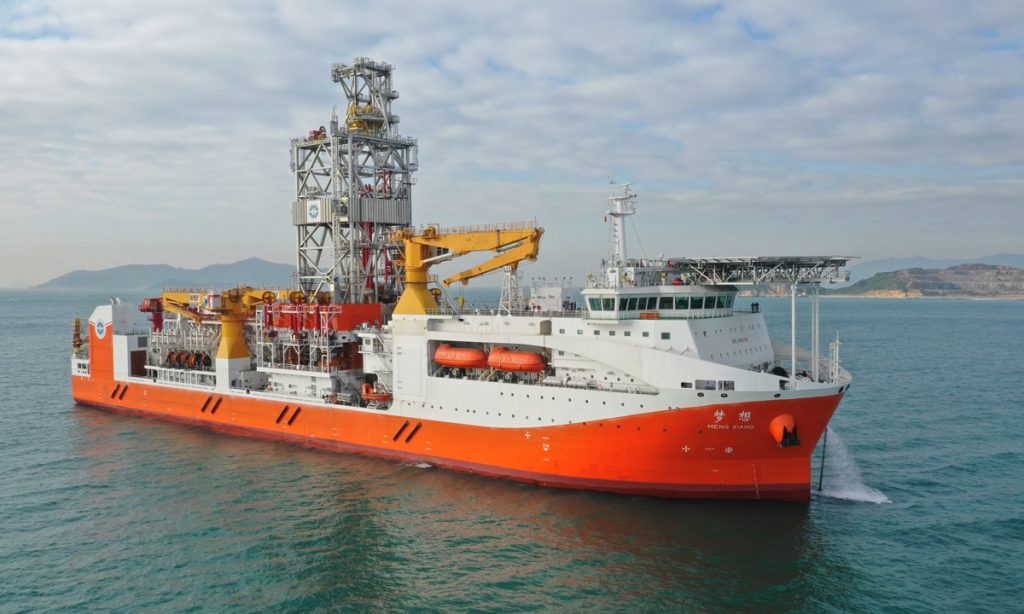
With the completion of the first trial voyage of China's first domestically built drilling ship, the Mengxiang (Dream in English), the country officially became another country in the world - following the US and Japan - to possess its own professional ocean drillship, which is dubbed as the aircraft carrier in marine science.
With this ship, Chinese scientists will certainly make greater contributions to international deep ocean drilling, Tuo Shouting, director of the International Ocean Discovery Program (IODP)-China Office, told the Global Times in an exclusive interview.
On December 27, 2023, the Mengxiang completed its trial voyage in the waters of the Pearl River Estuary in South China's Guangdong Province, marking a step forward for China's deep-sea drilling research.
The ship sailed 500 nautical miles. The performance and various indicators of its main power and other marine systems all met relevant standards.
With a length of 179.8 meters and a width of 32.8 meters, the Mengxiang can travel 15,000 nautical miles and sustain itself for 120 days without returning to port.
The ship, featuring high stability and structural strength, can operate in unlimited navigational areas worldwide and drill as deep as 11,000 meters in the sea.
Boasting a world-leading marine drilling capacity, the ship will drill through the Earth's crust and into the upper mantle, contributing to the exploration of the Earth's history and dynamics.
The mantle, accounting for four-fifths of the Earth's volume and three-fourths of its mass, is full of scientific mysteries waiting to be explored by scientists.
Construction of the Mengxiang kicked off in November 2021 and is planned to be comprehensively completed in 2024. The ship was officially named Mengxiang on December 18, 2023, when it started its trial voyage.
"The vessel not only carries the dream of the Chinese people to build a maritime power, but also carries the dream of global scientists to 'penetrate the Moho discontinuity and enter the upper mantle,' and carries the dream of human beings to develop deep Earth resources," Li Jinfa, director of the Geological Survey under the Ministry of Natural Resources, told media when explaining the name of the vessel.
To make greater contributions
China has been a participant in the IODP for a long time. With the completion of the construction of the Mengxiang, China will be able to independently organize expeditions, just like the US, Japan and Europe, Tuo Shouting said.
He expected that, with the vessel, China can play a more significant role in international deep-sea drilling.
The IODP is an international marine research collaboration that explores Earth's history and dynamics using ocean-going research platforms to recover data recorded in seafloor sediments and rocks and monitor subseafloor environments. The program now has more than 20 member nations.
China started to participate in the program as an associate member in 1998 and became a full member in 2014.
Currently, China sends eight to nine scientists every year to attend the voyages of the US drillship JOIDES Resolution to join global scientists to conduct research.
According to Tuo, the most prominent achievements of Chinese scientists in previous missions are the four ocean drilling expeditions in the South China Sea, through which Chinese scientists made a series of breakthroughs in the deep parts of the South China Sea, proposed new understandings related to climate change and basin formation, and challenged the traditional Atlantic model theory.
The achievements have helped China win the international leading position in deep-sea research in the South China Sea, Tuo said.
Due to the phased end of the IODP in 2024 and the planned retirement of the US vessel Resolution the same year, Europe and Japan are organizing and initiating the next phase of program. Therefore, China is also preparing to launch its own scientific plan and seeking to cooperate with Europe and Japan to jointly organize expeditions, Tuo said.
He revealed that China has already been compiling an IODP-China executive science (2025-2035) and the completion of Mengxiang will provide key equipment support for China-led expeditions in the future.
China-initiated ocean drilling will greatly enhance the country's innovation capabilities in deep-sea scientific research and observation, and development of intelligent equipment, Tuo said.
Moreover, ocean drilling has long been a "rich man's club" in the developed world, but the waters at the heart of many scientific problems lie within the exclusive economic zones of developing countries. China will actively expand international cooperation partnerships and build a Belt and Road ocean drilling alliance through cooperation with developing countries, especially those associated with the Belt and Road Initiative. This will promote China's platform to carry out expeditions globally and help more developing countries enter the field of deep-sea research, Tuo stressed.
"Cognitive Warfare" has become a new form of confrontation between states, and a new security threat. With new technological means, it sets agendas and spreads disinformation, so as to change people's perceptions and thus alter their self-identity. Launching cognitive warfare against China is an important means for Western anti-China forces to attack and discredit the country. Under the manipulation of the US-led West, the "China threat theory" has continued to foment.
Some politicians and media outlets have publicly smeared China's image by propagating false narratives such as the "China economy collapse theory" and "China virus threat theory," in an attempt to incite and provoke dissatisfaction with China among people in certain countries.
These means all serve the seemingly peaceful evolution strategy of the US to contain China's rise and maintain its hegemony.
The Global Times is publishing a series of articles to systematically reveal the intrigues of the US-led West's cognitive warfare targeting China, and expose its lies and vicious intentions, in an attempt to show international readers a true, multi-dimensional, and panoramic view of China.
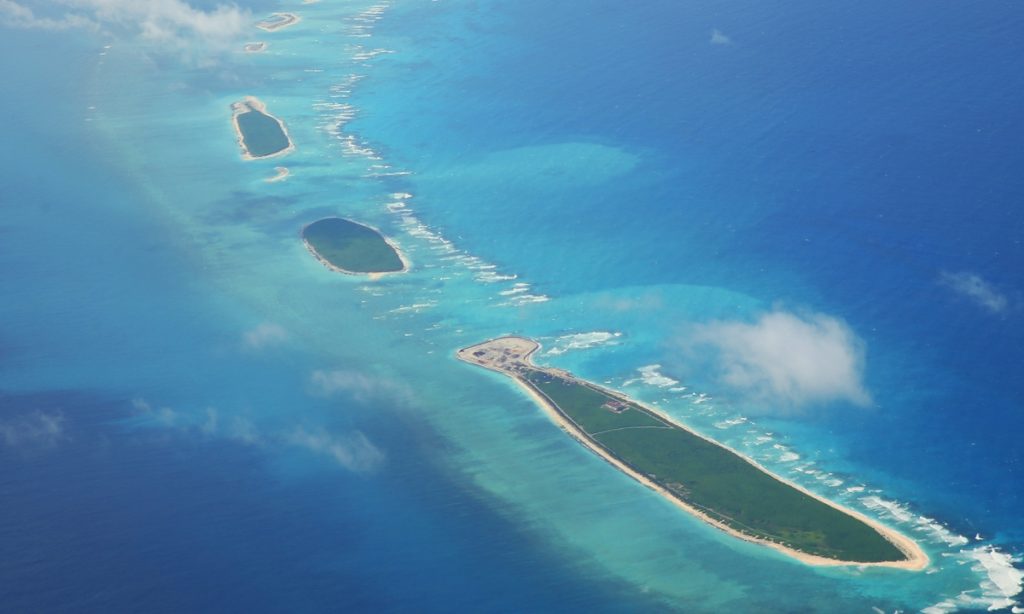
This is the eighth installment in the series. In this story, the Global Times looks into how the Group of Seven (G7) attempts to tarnish China's image and jeopardize the peace and tranquility in the region with various cognitive warfare tricks. The Group of Seven (G7) has been hyping the South China Sea issue synchronously under the US leadership. In the latest statement released earlier this month, the G7 once again claimed to oppose China's militarization activities in the South China Sea, and, not surprisingly, mentioned the so-called South China Sea arbitration.
These cliché accusations, as well as G7's repeated hypes of the South China Sea issue, have become "a part of the group's carefully planned cognitive warfare against China," said some Chinese observers reached by the Global Times. They pointed out that, through consistently creating strife in the South China Sea, provoking conflict between China and related countries in the region, and even inciting the latter to initiate troubles against China, the G7 attempts to harm China's sovereignty, denigrates China's international image, and jeopardize the peace and tranquility in this region.
The media disinformation campaign is far from the only means used, the Global Times found. Within the framework of the G7, governments, legal professions, media outlets, and academic institutes have largely participated in this cognitive war targeting China in terms of the South China Sea issue.
Murky blue sea interference
The G7, as one of the most powerful and influential intergovernmental political and economic groups in the West, is very good at attacking China over the South China Sea issue in the form of a joint declaration or statement by government heads or top officials among its members, to delegitimize China's rights and interests in the South China Sea at superficially "official" and "formal" occasions.
Apart from the latest statement, the G7 has released several similar joint statements detailing its "concerns" over the South China Sea issue in 2023 alone.
On November 8, 2023, G7 foreign ministers released a statement in Tokyo, stating that they "remain seriously concerned about the situation in the East and South China Seas," and "strongly oppose any unilateral attempts to change the status quo by force or coercion." Similar sentiments were also seen in another statement released after they met in New York in September.
Earlier in May, the G7 also hyped China-related issues in the G7 Hiroshima Leaders' Communiqué and other documents adopted at the G7 Hiroshima Summit, including irresponsible comments on the situation in the Taiwan Straits, and accusations regarding regions like the South China Sea.
Uniformly, these statements mentioned the South China Sea arbitration, saying the award rendered by the Arbitral Tribunal in 2016 "is legally binding upon the parties to those proceedings, and a useful basis for peacefully resolving disputes between the parties."
The fact is that the arbitration, without actual legal effect, has been widely considered a political farce under the cloak of law, said scholars of boundary and marine studies.
"The South China Sea arbitration was conducted by an arbitral tribunal without jurisdiction in violation of the procedures set out in Articles 283 and 298 of the UNCLOS (United Nations Convention on the Law of the Sea). There is no basis in international law, and it (the arbitration) has no legal binding force on China," said Wu Wei, an associated professor in China Institute of Boundary and Ocean Studies of Wuhan University.
Wu said that in 2023 since the US and the Philippines released the "Joint Statement of the US-Philippines 2+2 Ministerial Dialogue" in April, the US-led G7 has further meddled in the South China Sea issue.
"At the level of international law, it has violated the DOC (Declaration on the Conduct of Parties in the South China Sea), the UNCLOS, and the basic principles of non-intervention in domestic affairs," she told the Global Times.
Similarly, the "Limits in the Seas No.150" report that the US Department of State released in January 2022, which said it "examines the maritime claims of the People's Republic of China in the South China Sea" based on the UNCLOS, was also no more than a political tool of attack by the US against China under the guise of law, observers commented.
"The US itself has not ratified the UNCLOS," noted Wu. "Washington's interference in the South China Sea issue has hindered the normal implementation of the Convention." Hypes from media, academy community
G7 members have continually added fuel to the fire in the South China Sea issue, with Western media outlets amplifying their incendiary talking points. This year, US media outlets such as The New York Times, The Washington Post, and Time magazine have extensively reported on the maritime conflicts between China and the Philippines.
Throughout 2023, when the Philippine Coast Guard (PCG) stirred up trouble in the South China Sea, it contrived the accompaniment of local and Western media entities on many occasions, with mainstream Western media outlets such as the New York Times, NBC, and AFP being invited to join Philippine journalists. The Foreign Correspondents Association, representing foreign media in the Philippines, has also been in contact with the Philippine Department of Foreign Affairs and Department of Defense to coordinate journalists' boarding for interviews.
Presumably dissatisfied with journalists' inability to capture good photos on board, the US military has dispatched P-8A anti-submarine patrol aircrafts to assist the PCG in their resupply operations at Ren'ai Jiao (Ren'ai Reef). These aircrafts captured high-definition videos and photos, which were used for sensationalist purposes by Western countries and Philippine media outlets.
In an effort to assist the Philippines in its dispute with China, some third-party countries are seeking advice from their own think tanks. One notable case is that of Project Myoushu at Stanford University in the US, which focuses on South China Sea security issues.
In February, Project Myoushu claimed that "China harasses PCG vessel." Subsequently, the PCG asserted that a Chinese ship had directed laser at the PCG, and the US State Department spokesperson, Ned Price, further fanned the flames by stating that the US stands with their ally in the face of alleged laser incidents.
In the context of the Chinese Foreign Ministry's clarification of the facts and emphasis on the Philippine side's baseless accusations, Raymond Powell, Project Myoushu team lead and a retired US Air Force colonel, claimed that the actions of Project Myoushu pushed the Philippine government to finally decide to expose the maritime dispute between China and the Philippines.
In addition, the Asia Maritime Transparency Initiative at the Center for Strategic and International Studies (CSIS) is also a major project in the US that focuses on researching the South China Sea issue.
Over the years, this project has repeatedly accused China of "disrupting the status quo" and "threatening regional security" when releasing information about China's rights protection and law enforcement activities in the South China Sea.
However, it selectively ignores unilateral actions such as island construction and militarization by other claimant countries in the disputed waters.
In recent discussions between several US and the Philippine think tanks, various ideas regarding the US-Philippines cooperation in occupying Ren'ai Jiao were generated. In terms of logistical support, some have suggested that Western military forces should assist the PCG in delivering supplies to the grounded vessel, or even consider airdropping them using military aircrafts.
Currently, the Philippines is intensifying its propaganda campaign in the South China Sea in collaboration with foreign media sources and think tanks, using various tactics to overstate the severity of the conflicts between China and the Philippines in the South China Sea. Behind this is a mindset of sensationalism, deliberately portraying China as aggressively attacking and bullying a smaller country - the Philippines, Peng Nian, vice president of the Regional National Research Institute at the Hainan Normal University, told the Global Times.
"The more they exaggerate and amplify these negative incidents, the more it seems beneficial for the Philippines and the West. It not only maligns China, but also magnifies the South China Sea issue, continuously attracting international attention," Peng said. However, in reality, apart from escalating tensions in the South China Sea, these performers are only deceiving themselves with the illusion of enhanced influence, he noted.
A 'test site' to suppress China
The South China Sea is another "test site" for some Western countries, including the G7, to isolate and contain China, said observers.
By constantly hyping the South China Sea issue, they try to influence the international community and the Chinese public to force the Chinese government to change its foreign policy, Chen Xiangmiao, director of the World Navy Research Center at the National Institute for South China Sea Studies, told the Global Times in a previous interview.
To safeguard China's legal interests in the South China Sea, and to contribute more to the peaceful and stable development of the region, Wu from Wuhan University suggested that China should actively take countermeasures from multiple aspects, which include hosting summits for peaceful consultations between China and ASEAN (Association of Southeast Asian Nations) countries on the South China Sea situation, further encouraging fishermen to conduct fishing operations in the region with more guaranteed protection.
"It's also necessary to further promote international law studies on the South China Sea issue, to gain more say for China in today's global international law community on topics regarding this region," Wu told the Global Times.
Gone are the days when a handful of Western countries could willfully meddle in other countries' internal affairs and manipulate global affairs, said the Chinese Foreign Ministry on May 20, in response to the G7 Hiroshima Leaders' Communiqué released that same day.
"The international community does not and will not accept the G7-dominated Western rules that seek to divide the world based on ideologies and values. Even less will it succumb to the rules of exclusive small blocs designed to serve 'America-first' and the vested interests of the few," it noted. "G7 needs to reflect on its behavior and change course."
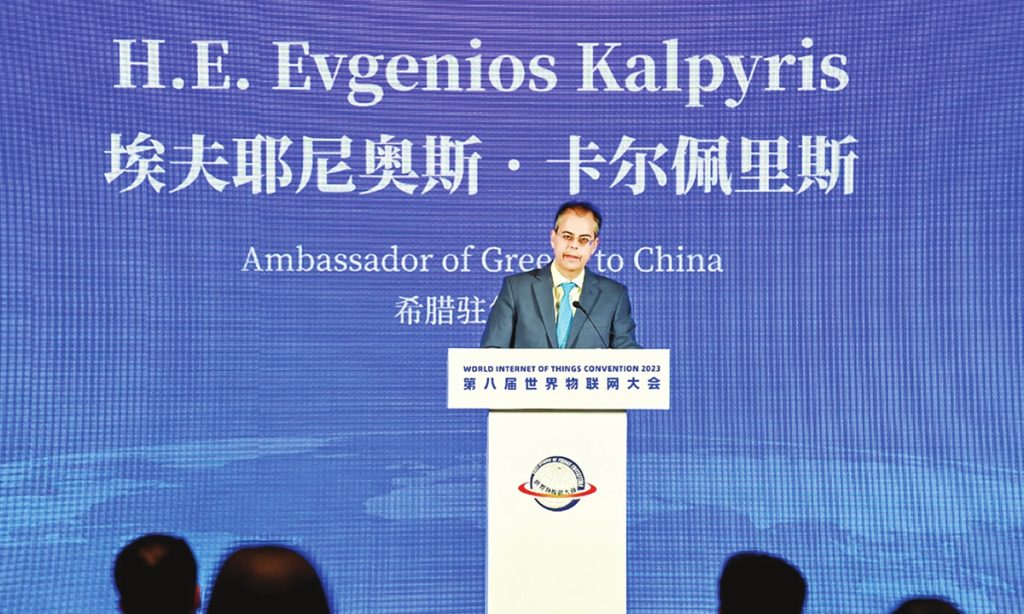
"The IoT (Internet of Things) is not simply a technological trend; it's a transformative force reshaping the economy in a new, interconnected era. The challenge for Greece, as for many other countries that do not lead the race but hope to not fall behind in this new reality- is to balance advancements and threats, particularly in the realm of security," said Evgenios Kalpyris, Greek Ambassador to China, in a speech on Monday when attending the opening ceremony of the 2023 World Internet of Things Convention in Beijing.
Ambassador Kalpyris shared relevant Greek development initiatives and fruitful achievements in terms of applying IoT in real estate, energy management, smart cities, digital agriculture, and industrial innovation.
He noted that, under the Greek Government's systematized regulatory and financing efforts, a significant economic transformation is under way. "One of the most recent and most promising Greek economic sectors to employ IoT is real estate," where companies partner with technology specialists to increase the efficiency of their businesses and create smart and sustainable buildings. Innovative real-estate applications process sensor data to lower consumption of resources, thus improving portfolio valuation while protecting the environment, Ambassador Kalpyris added.
Ambassador Kalpyris also intimated that the IoT project, Paros Island in Greece is underway, aiming to create "Europe's first smart island." It aims to redefine the relationship between cities and its citizens through advanced technological solutions, enhancing urban mobility.
The forum, themed "New IoT, New Economy, New Era," aims to promote the economic transformation and upgrading of all countries in the world, jointly building a Smart World supported by the IoT and embracing the United Nations Sustainable Development Goals.
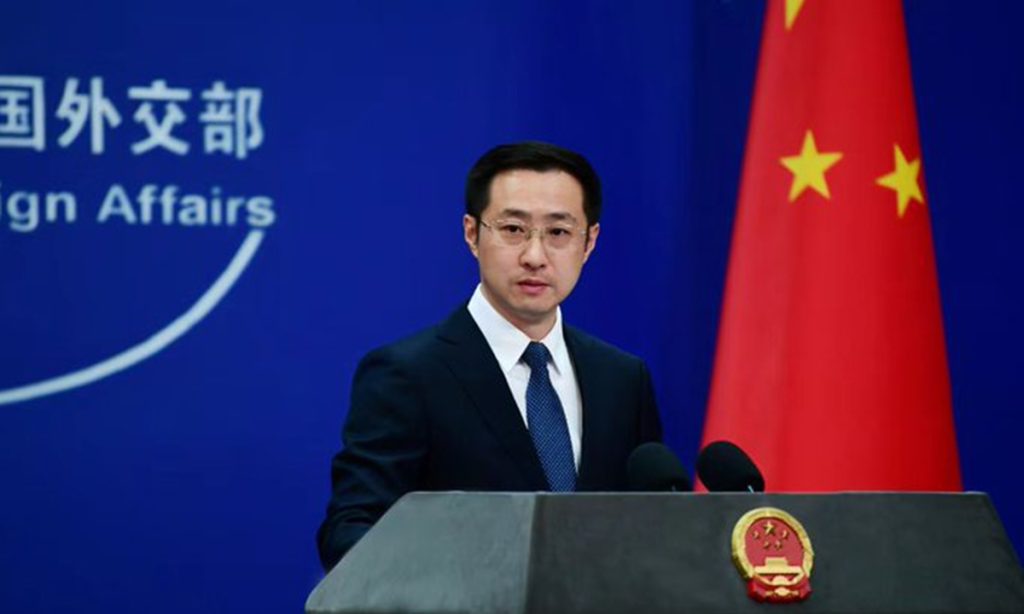
China urges the Czech Republic to honor its promises to strictly restrain certain individual politicians from sabotaging China-Czech relations, Chinese Foreign Ministry spokesperson Lin Jian said during a regular press conference on Tuesday.
Lin made the remarks in response to a question about Taiwan's so-called vice president-elect Hsiao Bi-khim visiting the Czech Republic and giving a speech at a think tank. Lin said explicitly that Taiwan is a province of China and does not have a vice president.
Lin said that China strongly opposes official interaction of any form between China's Taiwan region and countries that have diplomatic relations with China, and this position is consistent and clear.
In multiple official documents, including the joint statements and joint communiqué between the government of China and the Czech government, the government of the Czech Republic solemnly committed to stick to the one-China policy , respect China's sovereignty and territorial integrity and recognize that Taiwan is an inalienable part of the Chinese territory.
China urges the Czech Republic to follow its commitment, strictly restrain certain politicians, immediately stop the egregious moves that undermine the national credibility of the Czech Republic and its relations with China. "We urge the Czech Republic to take effective measures to undo the negative influence of the incident," Lin said.
"Our message to 'Taiwan independence' separatists is that whoever engages in 'Taiwan independence' will be held accountable by history; whoever in the world creates 'one China, one Taiwan' will get burned for playing with fire and taste the bitter fruit of their own doing," Lin stressed.
Later on the same day, Chen Binhua, spokesperson for the State Council's Taiwan Affairs Office, said that the so-called diplomatic breakthroughs adopted by the DPP authorities in the Taiwan region, in collusion with external forces, to achieve the goal of "Taiwan independence" have undermined the fundamental interests of the Taiwan compatriots, which cannot change the fact that Taiwan is a part of China, and are not conducive to peace and stability in the Taiwan Straits.
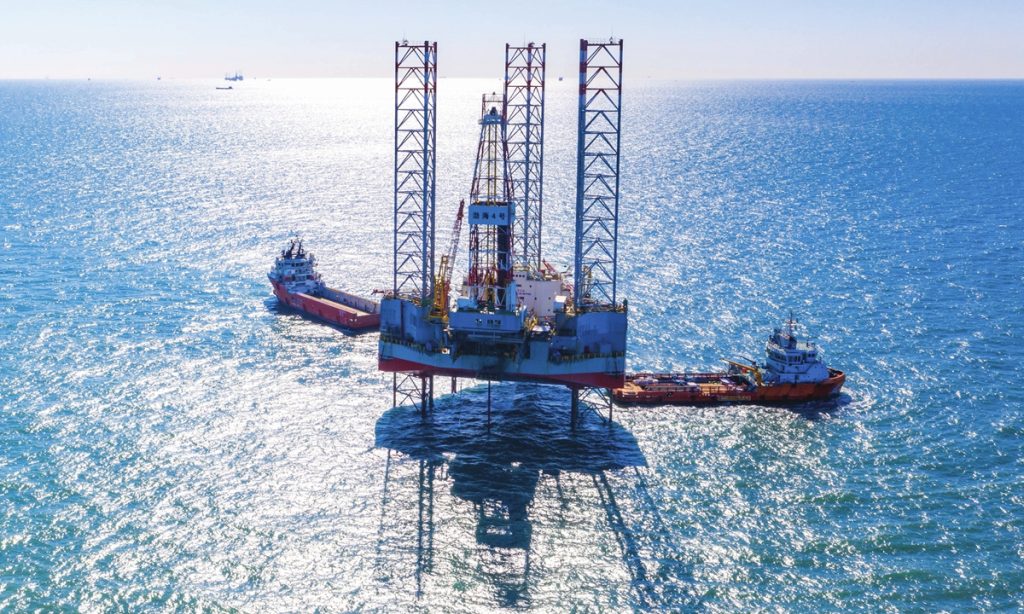
China has discovered a major oilfield in the central and northern parts of the Bohai Sea, with proven reserves of 104 million tons of oil, marking a monumental find in the region following a decade of search efforts, state-owned oil giant CNOOC announced on Monday.
The Qinhuangdao 27-3 oilfield, located 200 kilometers west of North China's Tianjin, is a 48.9-meter-thick oil layer in a 1,570-meter-deep well. With reserves exceeding 100 million tons of oil equivalent, testing has shown that the oilfield can produce about 110 tons of crude oil per day, showing promising exploration prospects.
With a regular extraction pace, the Qinhuangdao 27-3 oilfield could produce nearly 20 million tons of crude oil, enough to meet the daily transportation needs of a city with a population of a million people for over a decade. The refined asphalt could be used to build over 100,000 kilometers of four-lane highways, said Zhou Jiaxiong, a manager of CNOOC Tianjin branch.
The discovery of the Qinhuangdao 27-3 oilfield represents a successful practice of the company's new exploration strategy in the Bohai Sea. By changing the existing exploration approach, researchers identified the rich oilfield from a strike-slip fault zone in a complex structure area.
The Qinhuangdao 27-3 oilfield is the sixth 100 million-ton class oilfield discovered in the Bohai Sea since 2019 and the first in the central and northern parts of the sea in a decade, said Xu Changgui, deputy chief exploration engineer at CNOOC.
This discovery not only confirms the vast prospects for oil and gas exploration in the complex strike-slip fault zones of the Bohai Sea but also injects strong momentum into the development of China's offshore oilfields. It will play a significant role in securing China's energy supply and supporting the coordinated development of the Beijing-Tianjin-Hebei region, Xu added.
The discovery of the Qinhuangdao 27-3 oilfield is part of China's ongoing progress in the oil and gas sector, with CNOOC having made significant discoveries in recent years, including the Bozhong 26-6 deep-reservoir oilfield in the Bohai Sea and the Baodao 21-1 gas field in the western South China Sea.
On March 8, CNOOC announced China's first deep-water, deep-reservoir oilfield in the South China Sea, the Kaipingnan oilfield, which has proven reserves of 102 million tons of oil equivalent.
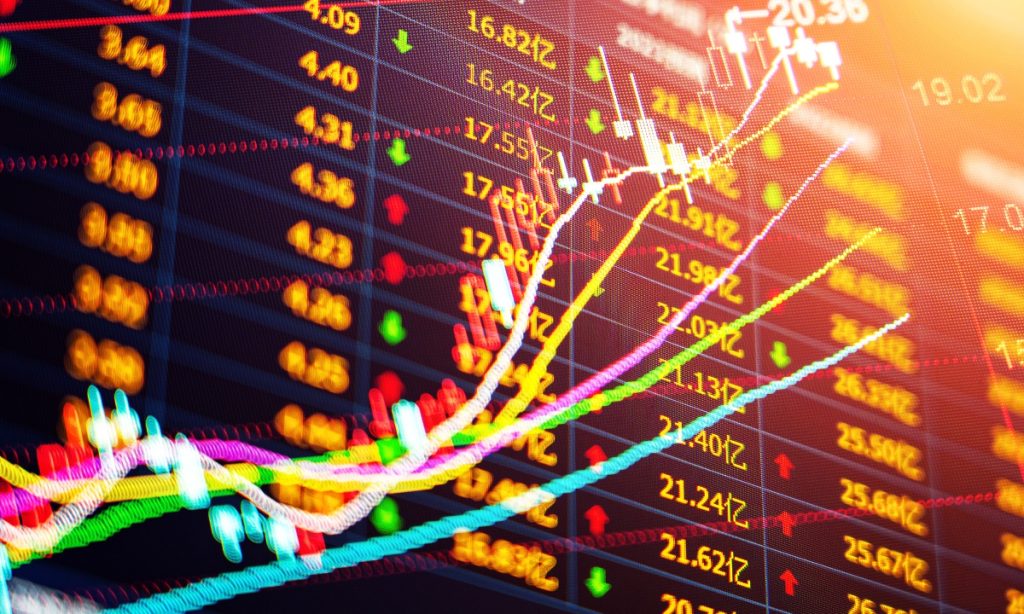
The Chinese capital market has shown signs of improvement, with an increase in active trading sentiment in fund products and a return of foreign inflows. Experts attribute the positive developments to recent regulatory efforts aimed at protecting investor rights and strengthening market regulation, adding that these measures are paving the way for long-term, high-quality growth in China's capital market.
Chinese real estate investment trusts (REITs) are experiencing a resurgence in market sentiment, with multiple cases of "single-day sellouts."
A clean-energy REIT product managed by Harvest Fund announced the early completion of its fundraising due to strong investor demand on Tuesday. Last week, an expressway REIT product under E Fund Management, ended the subscription earlier than the originally planned date due to strong demand from investors.
The Anxin Changxin Enhanced Bond Fund, issued by Essence Fund, was established on Tuesday with a net subscription amount of about 8 billion yuan ($1.12 billion) and had more than 15,000 total subscribers during the fundraising period from February 26 to March 6, making it the largest fund of the year, the China Securities Journal reported on Tuesday.
Foreign money is trickling back in. An analysis by UBS Securities on Thursday said that the firm maintains a positive stance on A shares, with an optimistic and proactive attitude. With regulatory intervention and the overall improvement in liquidity, it expects the short-term rebound in the A-share market to continue.
On March 3, Goldman Sachs released a report stating that governance reforms focusing on valuation and shareholder returns will attract foreign capital, while maintaining a high rating for Chinese A shares. Morgan Stanley's latest report on March 5 indicated that global funds are returning to the Chinese stock market.
Recent positive changes reflect investors' high confidence in the market and its prospect of healthy development, experts said.
Following the eight-day Spring Festival holidays, the market has continuously risen, with the Shanghai Composite Index standing above the 3,000-point mark as of Tuesday's closing.
Several sectors have started to quietly rebound from their lows, and the market's profit-making potential is becoming more evident, Yang Delong, chief economist at the Shenzhen-based First Seafront Fund, told the Global Times on Tuesday.
The A-share main indexes experienced some fluctuations in Tuesday's trading. By the closing bell, the Shenzhen Component Index was up 0.51 percent and the ChiNext Index had increased 0.83 percent. A total of 3,700 stocks saw gains.
Total trading volume reached 1.15 trillion yuan, marking the second consecutive day it exceeded 1 trillion yuan. Northbound funds net buying hit 4.244 billion yuan.
Experts attributed the confidence to a steady stream of policy support by Chinese securities regulators to stabilize the market.
During a press conference on the sidelines of the just-concluded two sessions, Wu Qing, head of the China Securities Regulatory Commission (CSRC), emphasized the importance of prioritizing investors, combating financial fraud, and encouraging listed companies to engage in cash dividends and buybacks.
These measures are beneficial for boosting investors' confidence and the high-quality development of the Chinese capital market, Yang said.
The CSRC's focus on improving the quality of listed companies, promoting long-term investment concepts, enhancing basic systems, establishing more effective market regulation mechanisms, encouraging higher quality services, and implementing stricter regulatory enforcement all show the latest regulatory philosophy, Tao Chuan, an economist with Suzhou-based Soochow Securities, told the Global Times on Tuesday.
In particular, the CSRC has vowed to "take action decisively" when the market experiences "irrational and violent fluctuation, liquidity dries up, there is market panic or a severe lack of confidence, and other extreme situations," which helps to rebuild investor confidence in the capital market, Tao said.
In response to a recent notice from the State Council and People's Bank of China (PBC), China's leading payment platforms Alipay and Weixin Pay have introduced a series of measures to improve payment services for foreign nationals. This initiative marks China's latest effort to facilitate easier access for foreigners visiting the country.
Following the notice issued by the central bank and the State Council on Thursday, Alipay announced enhancements to its services for foreigners, including increased transaction limits, the ability to link international bank cards, and the introduction of new services such as multi-lingual support. It also supports 10 overseas online wallets to directly use Alipay's services.
Similarly, Weixin Pay, one of China's major payment platforms, updated the process for foreign users to link international bank cards by simplifying identity verification and registration requirements.
The changes have led to a significant increase in transactions through Weixin Pay with international cards, with the number of daily transactions in February 2024 rising nearly fivefold compared to pilot phases of the services.
These measures stem from China's central bank and State Council's latest efforts to improve online payment services and reflect China's commitment to implementing a high-level of opening-up.
On March 1, PBC announced measures to guide Chinese payment platforms to increase the single transaction limit for foreign nationals using mobile payment services from $1,000 to $5,000 and the annual transaction limit from $10,000 to $50,000, as part of efforts to enhance payment convenience.
On Thursday, the State Council revealed plans to improve payment services for international consumers at various tourism and entertainment venues, both online and offline. The central bank also stressed to continue enhancing mobile payment convenience for foreigners and to optimize the environment for using bank cards and cash.
The new measures are expected to significantly ease consumption by foreigners in China, a country known for its widespread adoption and large scale of mobile and online payment systems. According to data from Bank of China, from February 9 to 14, the China UnionPay and NetsUnion Clearing Corporation processed 15.38 billion online payment transactions, amounting to 7.74 trillion yuan ($1.08 trillion), reflecting a year-on-year increase of 15.8 percent and 10.1 percent respectively.
In a related move to attract more foreigners to China, Foreign Minister Wang Yi announced on Thursday that from March 14 China will waive visa requirements for citizens from six European countries, including Switzerland, Ireland, Hungary, Austria, Belgium and Luxembourg. It is expected to further boost tourism and promote China's ongoing efforts toward greater openness.
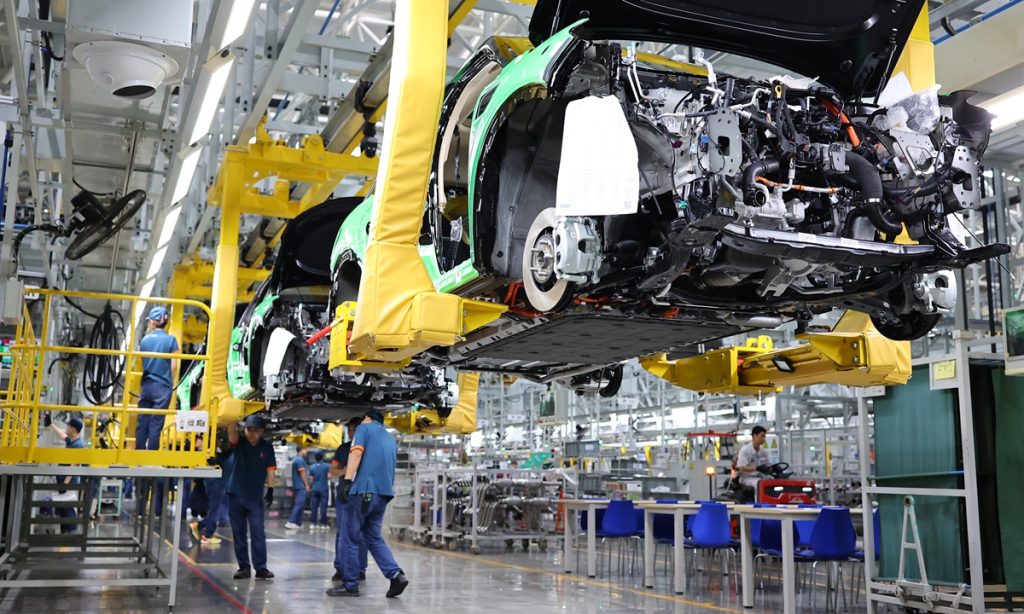
The US' escalating suppression of China's auto industry is a typical example of the politicization of trade and economic issues, experts said on Wednesday, warning that the US action will backfire and will hinder the development of the world's auto sector.
Republican US Senator Marco Rubio on Tuesday proposed sharply boosting tariffs on Chinese vehicle imports to stop the country "from flooding US auto markets," as part of Washington's latest effort to protect American automakers and auto workers, according to Reuters.
The report said that Rubio is also proposing legislation to extend tariffs to vehicles produced by Chinese automakers in other countries like Mexico and to limit subsidies for electric vehicles to those that meet stringent North American free trade rules.
"This is a manifestation of the US politicization of auto trading. After the 5G industry represented by Huawei, the US has made new-energy vehicles the second target to restrict China's technological development," Zhang Xiang, director of the Digital Automotive Intliu ernational Cooperation Research Center of the World Digital Economy Forum, told the Global Times on Wednesday.
Zhang noted that using so-called "information security," a completely trumped-up charge, the US has enhanced its suppression of Chinese automobiles, even though this is unilateral and violates international free trade norms.
"Blocking Chinese car imports will affect the progress of the US auto industry, as the US' new-energy technology is relatively backward compared with the level in China. If the Biden administration is determined to pursue this, raising tariffs will also have a big negative impact on the world's auto industry," Zhang warned.
Rubio's proposal is just a fresh move among an array of unreasonable US measures to suppress China's car industry. As the US elections in November approach, the administration of President Joe Biden and some leaders in Congress continue to speculate about restricting imports of Chinese electric vehicles.
On February 29, the White House said that the Biden administration is taking "unprecedented action" to protect Americans from the national security risks posed by internet-connected vehicles from countries of concern, including China.
US Commerce Secretary Gina Raimondo also peddled the "threat" theory against China's vehicles. "Cars these days are like an iPhone on wheels… You connect your phone and you might receive the text message… Imagine a world with 3 million Chinese vehicles on the roads of America, and Beijing can turn them off at the same time."
In response, Mao Ning, spokesperson from China's Foreign Ministry, said that Chinese-made cars are popular globally not due to the use of "unfair practices," but by emerging from fierce market competition with technological innovation and high quality.
"China's door has been open to global auto companies, including US auto companies that fully shared in the dividends of China's big market. By contrast, the US has engaged in trade protectionism and set up obstacles including discriminatory subsidy policies to obstruct access to the US market by Chinese-made cars. Such acts of politicizing economic and trade issues will only hinder the development of the US auto industry itself," Mao noted.
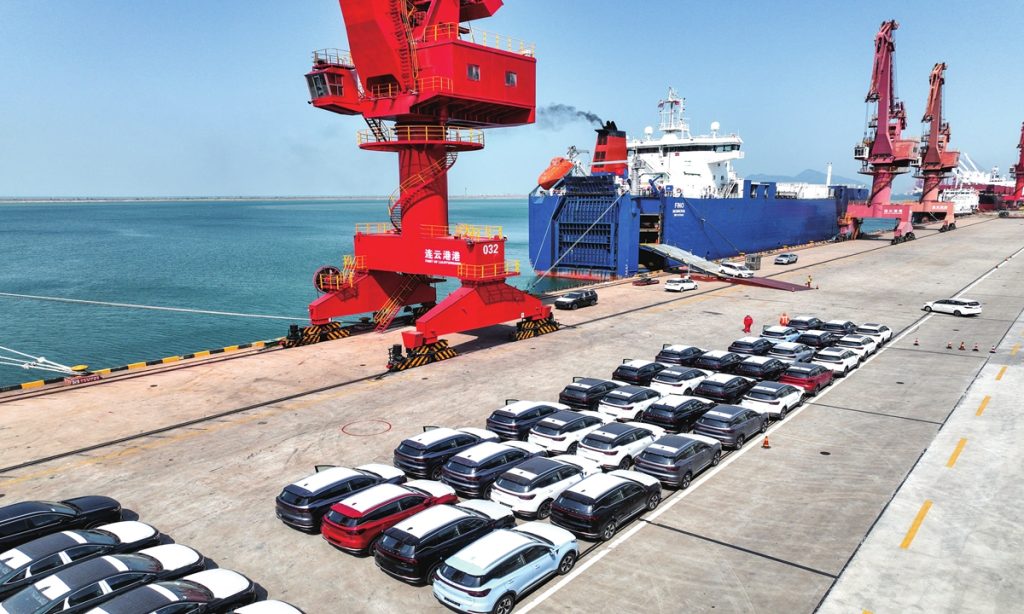
A deputy to the National People's Congress (NPC) called for efforts to tackle shortage and bottleneck in China's roll-on/roll-off (Ro-RO) cargo vessel capacity so as to improve transportation conditions of the country's surging new-energy vehicle (NEV) exports.
Deputy Yan Keshi submitted a motion to the ongoing NPC session in Beijing, noting that the limited capacity of Ro-Ro vessels has emerged as a significant problem hindering the export of Chinese NEVs, which Yan said warrants urgent attention.
Rising output of NEVs is an important contributor to China's economic growth. Last year, export of NEVs rose 77.6 percent from a year earlier, standing at 1.203 million units, which accounted for almost one-third of the global market share, Yan wrote in his motion.
But, China is experiencing a pronounced supply-demand imbalance in ocean transportation capacity, especially in the shipment of NEVs. The higher weight of all-electric NEVs, about 15-25 percent weightier than ordinary petrol or hybrid vehicles, has exacerbated the shortage of Ro-Ro vessels in China, Yan said.
Yan put forward measures of facilitating long-lasting cooperation among ship manufacturers, ports and other stakeholders, in order to ramp up sustainable Ro-Ro vessels manufacturing and optimizing the hardware and software support for exporting NEVs.
The Government Work Report released on Tuesday highlighted China's automobile industry, showcasing the remarkable performance of Chinese NEV manufacturing and marketing in 2023. Domestic auto brands have now exceeded joint ventures in passenger car sales, solidifying the NEV sector as a cornerstone of China's growing manufacturing strength. Amid this backdrop, how to shore up ocean shipping capacity of Chinese-made NEVs has drawn rising attention.
In a related development, Da Fei Monaco, a new generation of dual-fuel-powered Ro-Ro vessel, successfully completed its first voyage from Yantai Port, East China's Shandong Province, carrying 4,631 vehicles bound for the US, on March 5.
In January, BYD's "Explorer NO 1" and SAIC Motor Cor's inaugural transoceanic Ro-Ro vessels also embarked on their maiden voyage from Chinese ports.
Chery Automobile Group, in collaboration with its shipyard in Wuhu, East China's Anhui Province, has established a NEV transport vessel manufacturing base in Weihai city, Shandong Province. Three large vessels with a capacity of 7,000 cars each have been ordered, according to the Securities Daily.